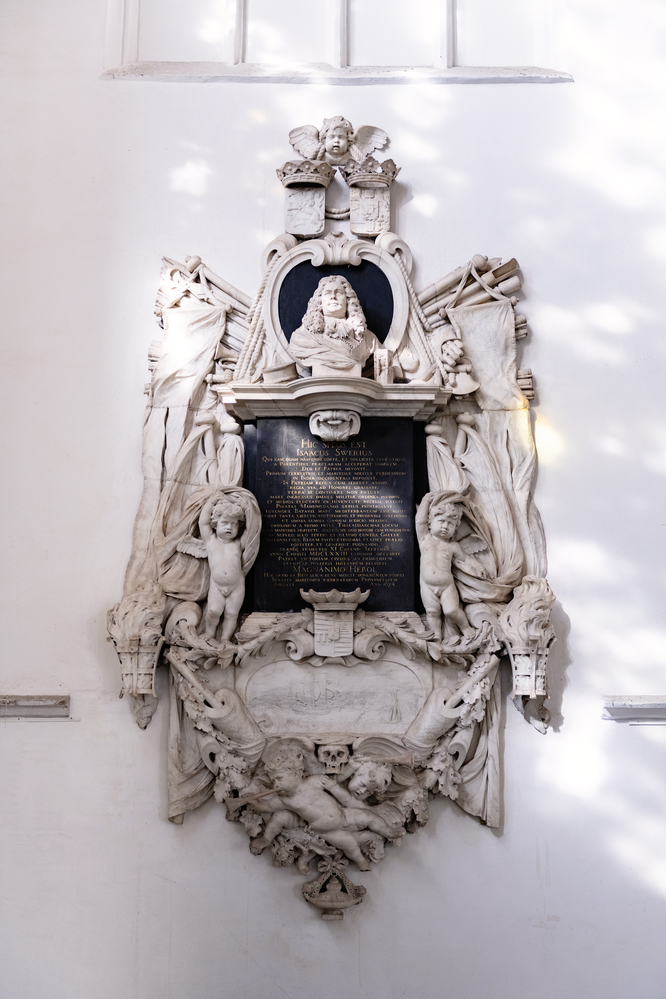
Memorial Stone for Isaac Sweers
Unlike many other mariners, Isaac Sweers did not come from a family of seamen. He led a turbulent life and managed to work his way up to vice admiral in the Admiralty of Amsterdam. Several events granted him the status of “sea hero,” and after his death he was not only buried in the Oude Kerk, but also honored with a memorial created by the sculptor Rombout Verhulst.
---
## Isaac Sweers' early life overseas
Isaac Sweers was born in Nijmegen to a family of civil servants and enjoyed a relatively prosperous childhood. He was educated at the French school, which was common for children from wealthy circles. After his education, he spent some time in Spain and England before leaving for Brazil in 1640.
Here he initially worked as a notary for the West India Company (WIC). When the Portuguese rebelled against the WIC in 1645, he was forced to serve in the army. The fort where he was stationed was surrounded, but despite his commander's orders, he refused to surrender. This led to his capture in Salvador.
## Isaac Sweers at the Admiralty of Amsterdam
In 1646 Sweers was released and returned to the Netherlands, where he joined the Admiralty of Amsterdam. He managed to work his way up to vice admiral, the third highest rank within the admiralty, and commanded several fleets during various naval battles. During the Battle of Kijkduin on August 21, 1673, he was killed; a heavy cannonball struck his lower body, legs and part of his face.
Several events in his life, such as his refusal to surrender in Brazil and his death on the battlefield, contributed to his status as a “sea hero.” After his burial in the Old Church, a mausoleum was crafted for him by renowned sculptor Rombout Verhulst, commemorating his life and extolling his heroism.
Throughout the centuries, the main emphasis has been on the heroism of naval heroes and their willingness to die for the fatherland. In current discourse, however, terms such as sea hero are critically questioned. After all, they played a major role in the colonial ambitions of the Netherlands, and their “heroism” has a strong nationalistic character.
## The Oude Kerk and the colonial history of the Netherlands
Over the centuries, the Oude Kerk grew into one of Amsterdam's most important religious and social centers. It was therefore a place where wealthy citizens and prominent families expressed their power and status. In Catholic times, this was done by founding chapels and altars. After the Alteration, influential Amsterdammers left their mark on the building by placing richly decorated tombs and powerful mayors were memorialized in the two [mayor's windows](https://oa.sharebox.nl/collect/4704-57).
More than half of the mayors who governed Amsterdam between the sixteenth and eighteenth centuries were directly involved with the United East India Company (VOC), the West India Company (WIC) or the Society of Suriname. Inscriptions on memorial stones praise influential citizens for their efforts as administrators within these bodies or remember them as “sea heroes.”
In other words, the grave monuments and mayor's windows show that the Oude Kerk is not separate from the colonial past of the Netherlands, but rather inseparable from it. Dealing responsibly with this past is a duty, but also a quest in which dialogue is central. By keeping the tombstones and mayor's windows visible, the conversation about the colonial past and the power relations that arose from it and still cause inequality today can be opened.
Several artists, such as [Iswanto Hartono](https://oa.sharebox.nl/person/8790) and [Ibrahim Mahama](https://oa.sharebox.nl/person/81563), have made significant contributions to this ongoing conversation through their work. The [Come Closer dedicated to Jacob Matroos Beeldsnijder](https://oa.sharebox.nl/collect/2022A-CC2) also contributed to this.
| Period | 17th century |
| Notes | Isaac Sweers (1622-1673), admiraal, gesneuveld bij Kijkduin, 11-09-1673. |
| Location | Lysbeth Gavenkapel |
| Materials | Marble |
| Number of parts | 1 |
Part of
Read more
Related
Read more
Read more
Read more
Read more
Read more
Read more
Read more
Identifiers for references
| Oude kerk Adlib Collect priref | 1907 |