Sint-Joriskapel
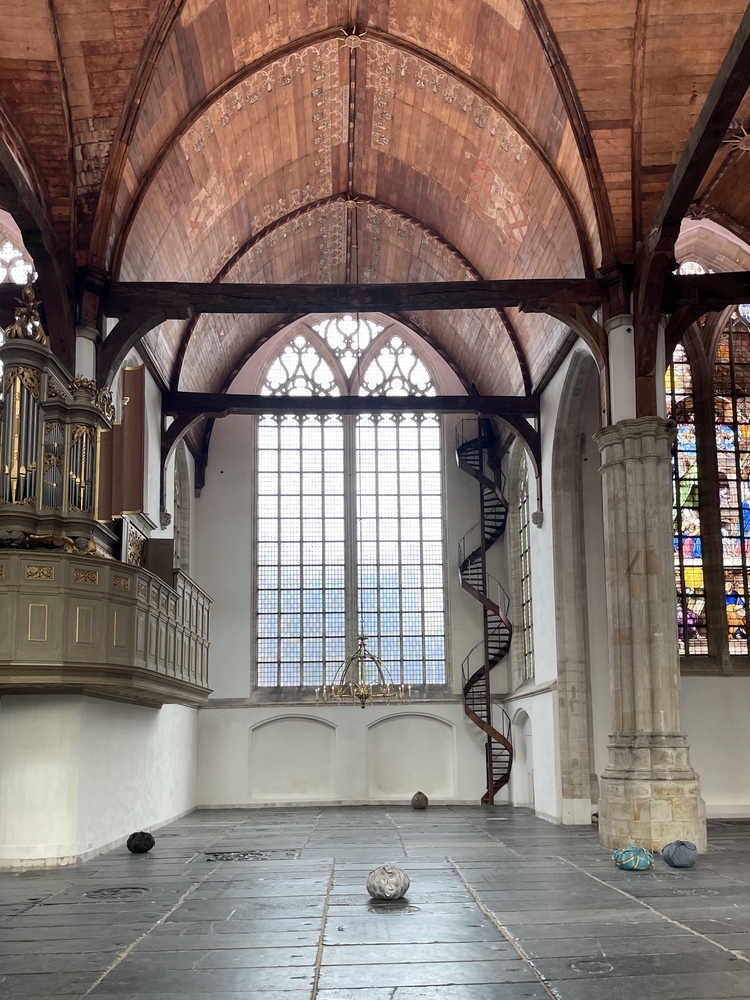
The Sint-Joriskapel was founded by the civic guard of foot archers, Amsterdam's oldest archery society. The patron saint of the foot archers, who practised the art of crossbow shooting, St George is said to have killed a dragon with his arrows. The image of a claw and the three coats of arms on the vault are references to Saint George.
This chapel forms the northern transept of the church. Construction began in about 1485. At that time, there was already a then admittedly smaller southern counterpart, which would later be extended into the present Sint-Sebastiaanskapel. Together, these chapels form the transept of the Oude Kerk.
---
## A critical note on the "schutterijen" (civic guards) in the Oude Kerk
After the Alteration, in addition to its religious function, the Oude Kerk increasingly took on a social role. It was not only a place of prayer, but also a place of gathering. Certainly the hand and foot archers were also an important part of this network. Unlike the craft guilds, which originally had a much more religious and professional character than the archers' guilds, the archers' guilds were above all also social associations where Amsterdam's elite came together.
This elite must be placed within a colonial context. The regent patriciate operated within a tight network, in which family ties and wealth were decisive. Their wealth was often directly linked to the trade in spices, slavery and colonial possessions. In addition, they held diplomatic positions within the city administration and in colonial institutions such as the Dutch East India Company (VOC) and the West India Company (WIC). Through social associations such as civic guards, they managed to maintain and expand their status and wealth. Above all, they jointly contributed to maintaining a colonial state that was responsible for exploitation and murder worldwide.
## The Consequences of the "Beeldenstorm"
In Catholic times, the Oude Kerk housed numerous statues of saints and altars dedicated to specific saints. These did not survive the Beeldenstorm - a period of iconoclast outbreaks throughout Northern Europe - and the subsequent Alteration. For Protestants, richly decorated altars and statues of saints were considered idolatry; they strove for a sober church interior that would not distract attention from worship. Using historical sources, it has largely been possible to reconstruct which statues and altars were located in different places in the church. There were three altars in the Sint-Joriskapel, two of which were dedicated to Sint Joris and one to Sint Pancras.
In addition, after the Alteration, the polychrome vault paintings of the Oude Kerk were painted over; this was also done to create a more austere church interior. During the restoration that began in 1955, the vault paintings were largely restored. Since then, the three coats of arms of St George have been visible again.
Explore the elements of the work
Read more
Read more
Read more
Read more
Read more
Read more
Read more
Read more
Part of
Read more
Related
Read more
Read more
Identifiers for references
| Oude kerk Adlib Collect priref | 2360 |